
Services
Strategic Governance Services
Delivering decision governance, risk management and benefits realisation
Op2i's strategic governance services encompass a range of activities all designed to ensure that stakeholder alignment, decision and risk insight, and benefits realisation is built into the transformation programme.
Core to Op2i's strategic governance services is the adoption of our proprietary software based system: Governance Director. (www.GovernanceDirector.com). Op2i uses it as both a consultative tool and governance system in helping businesses build better decision making, risk and compliance management processes, and as a joint governance system for sourcing partners.

Effectively managing the outsourcing programme is essential to realise the potential benefits and goals that an organisation sets for such programmes, however most organisations do not give sufficient attention to getting the relationship management and governance model right from the outset.
Significant benefits can be seen where the outsourcing relationship between the client and service provider is one that is built around a partnership approach, as opposed to a transactional view. However attaining and maintaining such a relationship requires effort, resources and upfront investment in getting the internal structures right.
Any outsourcing relationship that has no plan for continuous improvement and innovation in cost and quality, largely sacrifices the long-term advantages that outsourcing can secure. In turn, this negates any promise of strategic gain, which is one of the greatest gains in long-term competitive advantage that outsourcing can deliver.
It is not the sole obligation of the service provider to deliver such improvements. Outsourcing should not be treated as a commodity transaction.
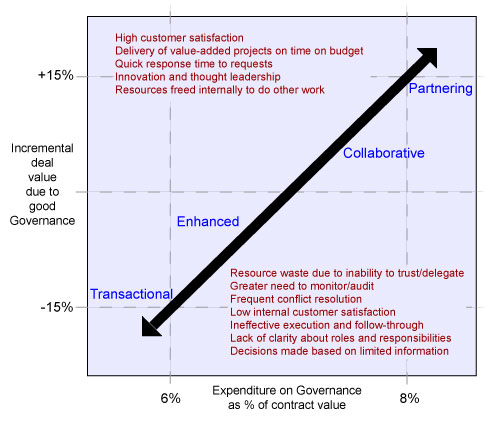
Our strategic governance services combine professional services and where appropriate the use of the GovernanceDirector system. We provide support and system support for three key areas:
[TOP]
Governance and risk management
Research suggests that more the half of outsourcing programmes fail to deliver on expectations. Many organisations spend between spend two percent or less of an outsourcing contract’s cost on governance, with more than 60 percent report losing 10 percent or more of the contract’s value because of poor governance between the customer and the provider. More successful organisations focus on good governance, understand and commit to the establishment of governance structures and the relationship. These organisations typically spend between five to seven percent of the contract value on Governance, but over the longer term see greater business value from their outsourcing programmes.
The outsourcing process contains significant risk and complexity for any organisation and a robust governance structure, supported by appropriate tools is fundamental. It is critical to the development of a healthy relationship, for the quick and effective resolution of issues, the management of change and for collaboration to take place.
Op2i believes a robust governance structure must enable management to make decisions that increase the business value derived from the outsourcing relationships, while reducing risk. For us, good governance is about ensuring:
- The right decisions are made involving the right people in a timely manner.
- Decisions are made in the context of a well defined and shared understanding of the organisation's vision and mission.
- Decision validity is tested on the basis of its alignment with the organisation vision and mission.
- Decisions have risk assessment and analysis at their heart and are routinely tested for compliance against applicable regulations and standards.
- Change is recognised as being a normal business condition and so the expectation of change is instilled at the heart of Governance Processes.
- It is an enterprise wide philosophy and business culture that is enacted by all stakeholders within the organisation.
- It is not just about decision, risk and compliance but about creating an environment which provides visibility and which helps create discussion and debate.
- It is not something that is installed as a top down or bureaucratic structure but rather as a strategic helping hand for all levels of the organisation.
Formal governance boards and steering committees are essential, but informal stakeholder involvement is the way successful relationships are built and maintained over time. Stakeholder involvement results from an effective combination of information exchange and action. Stakeholder alignment between the client company's goals and the service provider's actions has long been considered the Holy Grail of outsourcing. Yet alignment can be elusive. We believe it is better to seek alignment around mutually beneficial outcomes through joint decision making and through alignment of decisions to the jointly agreed vision of the relationship. This joint governance approach also leads to increased levels of trust - when trust is high and commitment to achieving the agreement's goals is shared, customer satisfaction becomes a key success ingredient that's jointly nurtured by both sides.
Good governance must have a transparent decision making process with clearly defined responsibilities and accountability at the operational, executive and board levels.
Op2i's governance and risk management services include:
- Development of robust governance structures or for experienced clients, a review of the current governance framework and processes within and between the parties, with recommendations for improvement.
- Help in identification, documentation and management of programme risks and issues through engagement with key stakeholders and the use of our Governance Director system.
- Programme delivery planning with achievable milestones; clear roles and responsibilities, and accountability for deliverables, communications and reporting.
- Development of a robust methodology for developing and implementing a risk and compliance management strategy.
- Use of Governance Director to enable effective management of SLA performance, risks and issues, with the provision of dashboards, alerts, and drill-down analysis.
Service delivery management and benefits realisation assurance
As is the case with respect to any material agreement, the structure of the outsourcing agreement is crucial because it embodies the rights, remedies duties and obligations of the parties and provides a blueprint for the parties' relationship.
For most firms, the contract is the first thing they prepare and the thing they argue over the longest, and the last thing they use. Careful management of the delivery of duties under the contract is an essential function in order to affect the successful delivery of contracted services.
However effective benefits realisation must start with the appropriate strategy in the first place, with the appropriate commercial model which drives the contract.
Op2i helps clients identify key business drivers, develop relationship vision and objectives, increase stakeholder engagement that leads to stakeholder commitment, reduce programme risks and provide a means by which broader business benefits can be measured.
Op2i can provide the expertise (creating a manageable and transparent set of planned activities which can be tracked and monitored based on the contract) and systems to provide the oversight, support, tracking and management required to provide assurance in service delivery.
Our proprietary GovernanceDirector system provides the ability to capture and measure achievement of SLAs and benefits against targets. The software system provides multi-view benefits reporting and fast track issue and risk identification, reporting, work flow and action management. The system can also be used to monitor customer and service delivery satisfaction through a survey based review with key personnel. The software system can deliver full visual analytics on issue areas and make recommendations for closing the gaps, provide cluster analysis and help track the relationship over a period of time.
Innovation collaboration and partnership
Our experience to date, as with others in the industry shows that a lack of innovation and value add is one of the biggest disappointments of outsourcing customers today.
Providers aren't rewarded for bold moves and risk taking in existing deals, they are rewarded for standardisation and stability. This is a good recipe for cost savings and more effective standardised operations, but not one for innovation.
Innovation in outsourcing takes work and investment, and it involves some risk. Parties don't generally have a joint process for managing innovation. Innovation and value discovery requires customer and provider participation and support. The net result is that the delivery of innovation and continuous improvement in the delivery of services and increased benefit realisation is lost.
Op2i facilitates the management of new innovative ideas both both parties from screening, option evaluation, feasibility assessment and joint approval processes. This is provided through a combination of professional facilitation services, the creation of innovation forums which help ignite the creative process, as well as the provision of joint decision governance systems to support the innovation management process.